EDITOR’S NOTE: Everyone has a story — some more well-known than others. Across Western North Carolina, so much history is buried below the surface. Six feet under. With this series, we introduce you to some of the people who have left marks big and small on this special place we call home.
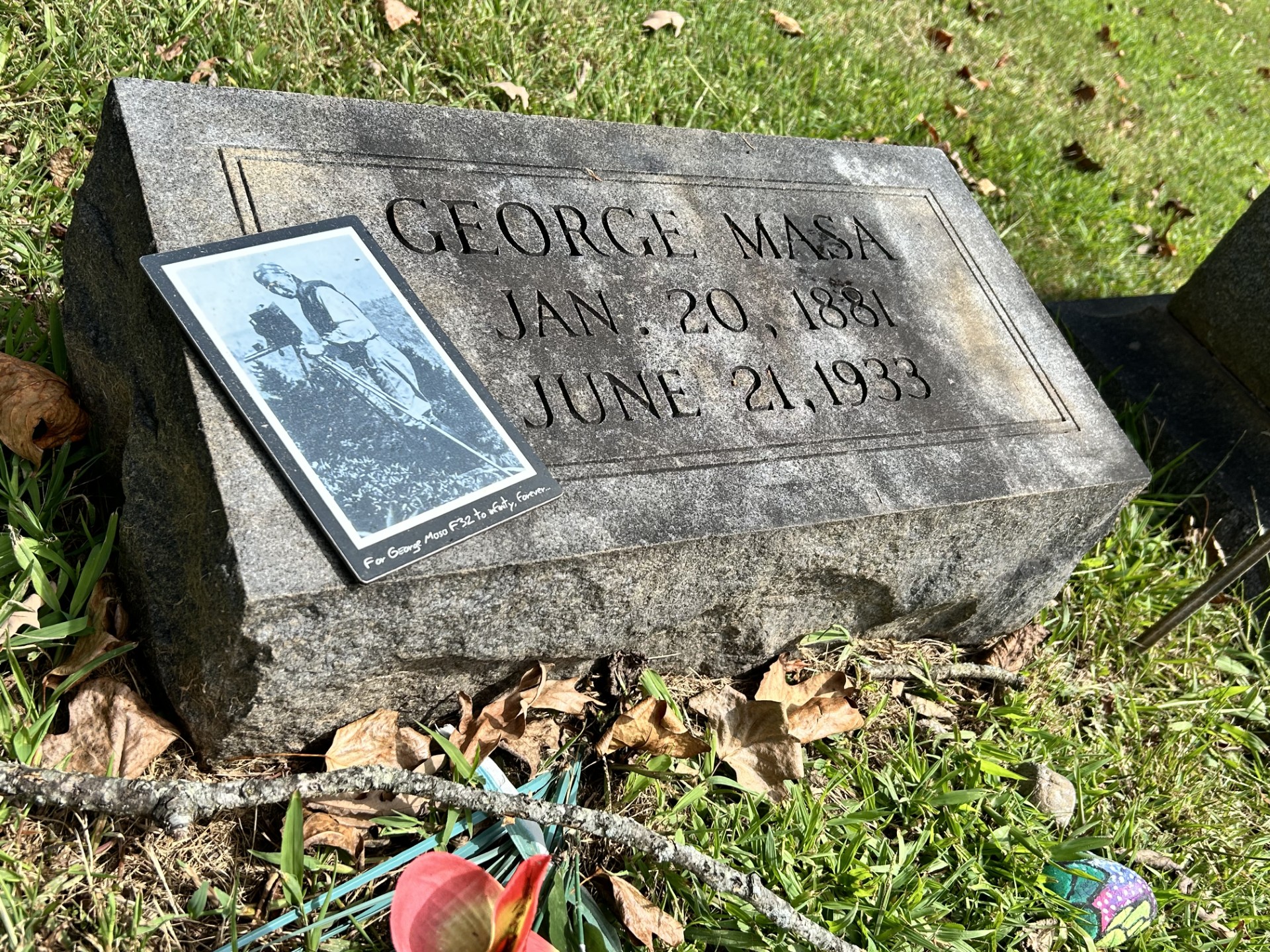
Photographer and conservation activist who lobbied for the creation of Great Smoky Mountains National Park, George Masa, ~1889-1933, is buried in Riverside Cemetery in Asheville.
—–
Masahara Izuka was born around 1889 in Tokyo, Japan. As he was pursuing a degree in engineering at Meije University, a Methodist missionary converted him to Christianity, which radically altered the trajectory of his life.
Upon conversion, Izuka stowed away on a ship bound for the United States, landing in California. Izuka changed his name to George Masa to assimilate. He enrolled at the University of California in order to study mining engineering.
For a short time, Masa used his education in Colorado as an engineer before moving to Asheville in 1915, taking a position as a laundry assistant at the Grove Park Inn. Masa worked his way up the ladder, eventually attaining the positions of valet and bellhop.
Apparently an entertaining figure, Masa gained notoriety with guests who took interest in his personality. The Grove Park Inn allowed Masa to meet the most esteemed travelers of the day, including future President Calvin Coolidge and his wife Grace.
Hoping to move to a larger city, Masa requested a letter of recommendation from his supervisor in 1916. His supervisor’s response was reporting Masa to federal investigators, claiming Masa had become too proficient in photography. Whatever the supervisor’s motivation was, Masa remained on staff at the Inn for another two years.

Masa eventually left the Grove Park Inn in 1918 when he became a partner at a photography studio. On Patton Avenue — between Broadway Street and Lexington Avenue — stands a marker demarcating the place where Masa’s studio once stood.
While his studio may have been stationary, Masa and his camera were anything but. His intent on capturing the perfect image knew no bounds, being known to hike for days for the perfect photograph.
Like many artists, Masa used his art form for advocacy. With a picture, Masa could accurately paint the portrait of the terrain that he feared would be lost to logging without conservation.
Perhaps his devotion to art as advocacy is what drew Masa to a deep friendship with Horace Kephart, whose art was writing. Their relationship was so close that Masa requested to be buried next to Kephart.
Kephart’s writing and Masa’s photography paired well together, offering the friends great opportunities for activism as a duo.
Cameras and their associated equipment were heavy at the time. To take the breathtaking shots he was known for, Masa lugged his camera for miles up mountains. He carried around half his body weight in supplies for the precious photographs.
Masa and Kephart worked on the committees responsible for creating Great Smoky Mountains National Park and the committee that planned the route of the Appalachian Trail through the park.
Without Masa’s photos, it is likely that Great Smoky Mountains National Park and the lower section of the Appalachian Trail would not have been completed. It was the visceral depictions within his art that provided the graphical impetus for lawmakers to side with the conservators.
Masa leveraged his connections to create the national park and trail. His kinship with the Coolidges and John D. Rockefeller Jr. proved invaluable for the success of the projects.
Rockefeller Jr. provided $5 million of his father’s oil slick dollars for the land acquisitions necessary for the park. In that sense, Masa’s connection to the son of the tycoon was very valuable.
Perhaps more helpful, however, was the photo Masa took of Rockefeller Jr. A national icon on a peak in a soon-to-be national park left readers of the New York Times with intrigue for the project.
Despite leaving behind his engineering career many years prior, his skills would crop up again later. Masa made an instrument out of an odometer and a bicycle wheel to measure distances, using it to map much of the topography of the lower Appalachian range with the assistance of Kephart.
Like many other Americans, the Stock Market Crash of 1929 bankrupted Masa. He never financially recovered.
On top of the financial loss, Masa would lose something more important, his friend Kephart, in a car accident in 1931.

Months after Kephart’s death, Great Smoky Mountains National Park was finalized, realizing the dream he and Masa had fought for.
Two years later, Masa coordinated a hike in commemoration of Kephart. Masa fell ill during the trek and was taken to the county hospital, not having enough money to pay for his own physician.
On June 21, 1933, George Masa died of a respiratory infection, possibly tuberculosis or influenza, in Asheville.
Masa was buried in Asheville’s Riverside Cemetery against his wishes. Horace Kephart was nowhere nearby, having been buried in Bryson City, North Carolina. Dying penniless, Masa did not have the means to be laid to rest next to his friend.
In 1968, a peak in the national park Masa worked so hard to create was christened for him. Masa Knob stands at 5,685 feet, towering over nearly everything in its immediate vicinity, everything except the neighboring Kephart Peak, named for his friend, rising above the terrain at 6,217 feet.

The photographer is remembered fondly in the conservationist community as a trailblazer for the preservation of Western North Carolina and East Tennessee.
Today, Great Smoky Mountains National Park is the most visited national park, with the number of annual attendees rivaling the largest amusement parks.
MORE TOMBSTONE TALES:
- Tombstone Tales: The final resting place of a music pioneer
- Tombstone Tales: Daredevil pilot buried in Black Mountain
- Tombstone Tales: A resort, the Civil War, a book and 2 cemeteries
- Revolutionary War heroes buried in Asheville
- Bill Nye the Humor Guy buried in Fletcher
- ‘American Godfather’ buried at Riverside
- ‘The Gift of the Magi’ author buried in Asheville
- Former slave, Union soldier buried in Asheville
- 1st female legislator in the South buried in Asheville
- Actress, activist Dorothy Hart buried in Asheville