ASHEVILLE, N.C. (828newsNOW) —
EDITOR’S NOTE: Everyone has a story — some more well-known than others. Across Western North Carolina, so much history is buried below the surface. Six feet under. With this series, we introduce you to some of the people who have left marks big and small on this special place we call home.
American Revolutionary War veterans and state lawmakers Zebulon Baird (1764-1824) and David Vance (1745-1813) are reportedly buried in Riverside Cemetery in Asheville.
—–
The grandfathers of North Carolina’s infamous Civil War Governor Zebulon Baird Vance, for whom the Vance Monument once stood in Asheville, were heroes of the American Revolutionary War.
A marker in front of the Buncombe County Judicial Complex at 181 College St. in Asheville dedicated “To Honor the Revolutionary Soldiers Buried in Buncombe County, N.C.,” lists Zebulon Baird and David Vance.

Zebulon Baird (1764-1824)
Zebulon Baird was born to William Baird and Margaret O-Reiley on Aug. 3, 1764, in Morristown, New Jersey.
Baird moved south after several deaths in his immediate family, taking most of his siblings and widowed mother with him. The Bairds stopped their covered wagon in Morganton.
Baird and his brother made their fortunes in Western North Carolina as merchants, owners of a grist mill and buying and selling land in a small town called “Morristown,” which later became Asheville. Baird donated the land for the first city hall.
Not much is known about Baird’s service in the Army, however, it is known he served as a captain during the American Revolutionary War.
Making history during their merchant expeditions, Baird and his brother lugged the first covered wagon into Buncombe County in 1793, having to push it up mountains through a dry creek bed because there were no roads wide enough for a wagon.
Baird went on to a political career in the burgeoning nation, serving several terms in the North Carolina House of Commons and Senate from 1800-22. Likely remembering the horrors he must have faced with that wagon, Baird’s primary achievement in elected office was the funding of the Buncombe Turnpike, a 75-mile route connecting South Carolina to East Tennessee through Western North Carolina.
Baird married Hannah Erwin. The couple had seven children. Most notable was their daughter, Elmira “Mira” Margaret, who became the mother of Zebulon Baird Vance.
Baird died in his home near Asheville on March 9, 1824, after reportedly falling from his horse and falling ill. His grave could not be located though he is said to be buried in Riverside Cemetery.
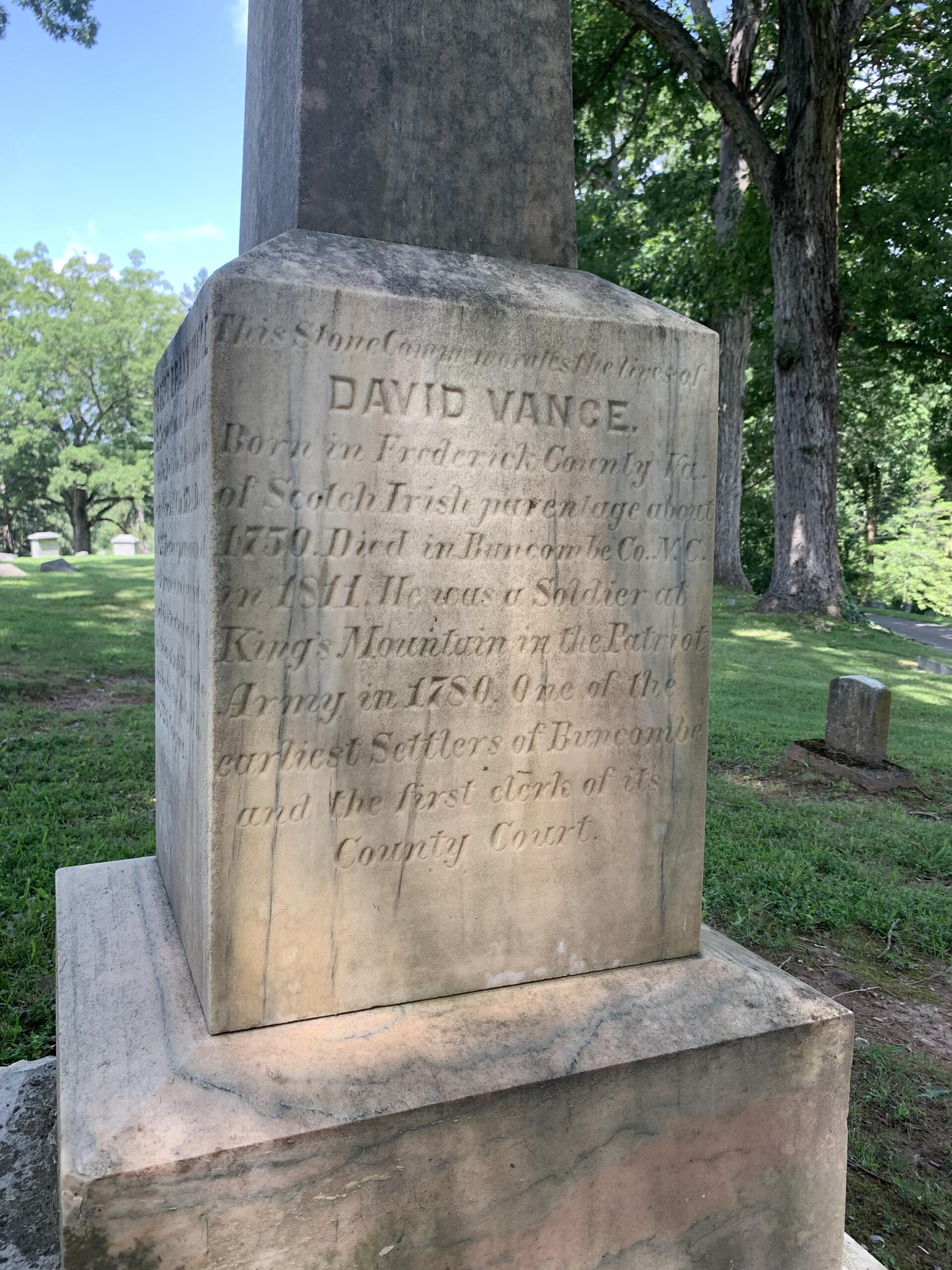
David Vance (1745-1813)
David Vance Sr. was born to Samuel Vance Sr. and Sarah Colville on Aug. 25, 1745, in Frederick County, Virginia.
Vance moved to Rowan County in 1774 and married Priscilla Brank a year later. The couple had eight children, most notably David Vance Jr., who became the father of Zebulon Baird Vance.
Unlike Baird, Vance’s role in the Army is known. He served in the battles of Brandywine, Germantown, Valley Forge and Kings Mountain. Because of his service, he achieved the rank of captain.
After the war, Vance moved his family from the Catawba Valley to the Reems Creek area north of Asheville. The land the Vances settled on is now a State Historic Site — Vance Birthplace.
Vance was one of three men selected by the State Legislature to survey and settle the border between North Carolina and Tennessee.
Like Baird, Vance was a man of public office, serving in the state legislature for several terms. Notably, Vance, along with Col. William Davidson, were responsible for introducing the bill that created Buncombe County in 1791, carving it out of Rutherford and Burke counties.
Vance also served as the Buncombe County Clerk of Court, a role he held from 1792 until his death.
Vance died of a heart condition on Jan. 13, 1813, in Asheville. He is buried in Riverside Cemetery.
MORE TOMBSTONE TALES:
Bill Nye the Humor Guy buried in Fletcher
‘American Godfather’ buried at Riverside
‘The Gift of the Magi’ author buried in Asheville